Weather on Earth is highly influenced by events on our sun. On top of that, the amount of solar spots, flares and Aurora Borealis have a remarkable effect on radio wave propagation in the ionosphere of our planet.
High frequency (HF) communication frequencies are also used as a backup for aircraft crossing oceanic and other sparse areas where VHF communications falls short due to its line of sight properties. Nowadays SATCOM is being used for global communication but these can also be influenced by very high ionization levels during intense solar activity.
Thus, we felt we needed to include solar information so that pilots, using these HF (sometimes they even work aeronautical mobile as a radio ham operator during these long haul flights) and SAT frequencies, can prepare themselves.
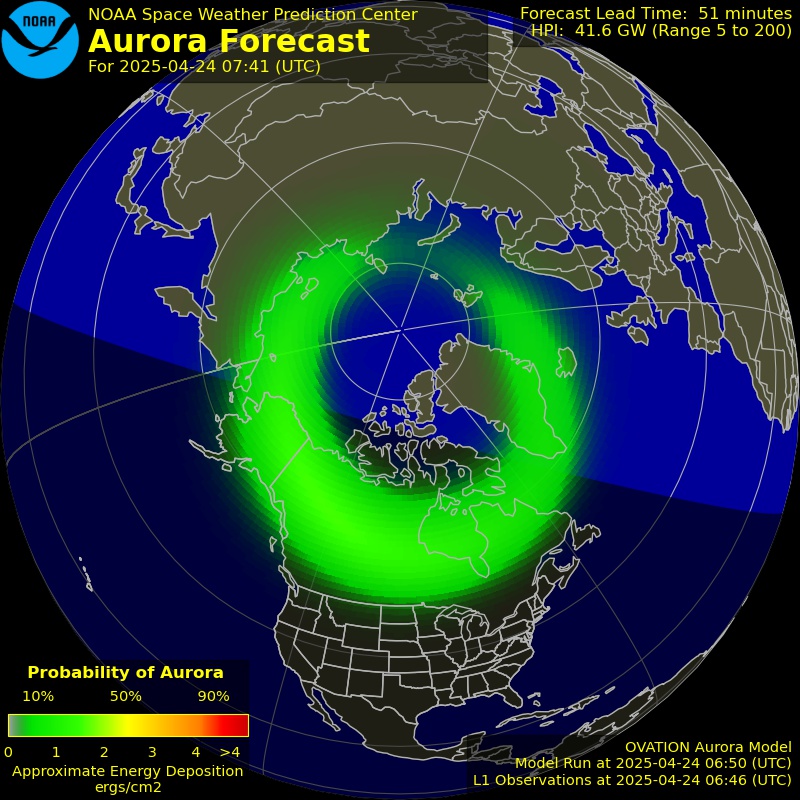
To the right you will see the intensity of the Aurora oval over the North Pole. This is the result of solar flares entering the Earth's magnetic field. Click the image for more info, or the next link for the South Pole Aurora image.
The information presented here is sourced from other websites so if some of the images do not show up its because they probably could not be retrieved at that time, try again later or refreshing this page might help.
Now that the sun is coming out of a sun spot low (2009) the effects can eventually be noticed on HF and VHF frequencies. Especially on shortwave frequencies where long range communications can take place between aircraft and ATC or their home base. This solar cycle 24 (2009-2020, click for image) was not as intensive as the previous one. It seems that we are heading in the direction of a new Dalton or even a Maunder minimum.
From spaceweather.com: "A solar flare is an explosion on the Sun that happens when energy stored in twisted magnetic fields (usually above sunspots) is suddenly released. Flares produce a burst of radiation across the electromagnetic spectrum, from radio waves to x-rays and gamma-rays."
This radiation is measured by Geostationary Operational Environmental Satellites (GOES) and plotted on a so called X-Ray Flux plot. To see these plots click on the 5 minute X-ray Flux for a three day overview or on the 1 minute X-ray Flux for a six hour monitor.
NOAA.gov: The GOES X-ray flux plot contains 1 and 5 minute averages of solar X-rays in the 1-8 Angstrom (0.1-0.8 nm) and 0.5-4.0 Angstrom (0.05-0.4 nm) pass bands. Data from the SWPC Primary GOES X-ray satellite is shown.
The sun also emits high energy protons during flares, when these particles reach Earth they can block out HF transmissions for polar paths. The next link opens a window with the latest 3 day GOES Proton Flux.
The effects of extreme solar radiation are listed on this NOAA Space Weather Scale page. For more information visit the NOAA Space Weather website.
Geomagnetic effects from the sun can be seen in this 3 hour Kp-Index from the NOAA Space Weather Prediction Center, if the index is higher than 5 then a geomagnetic storm is in progress. Other Space monitors from NOAA can be found here .

The basis where solar flares emit, these are planet sized regions, where the temperature is cooler than the surrounding area and where magnetic loops poke through the surface. The exact generation of sunspots is not quite clear but they seem to be related with the amount of activity in the sun. The amount of sunspots vary approximately in an eleven year cycle and the number of sunspots per cyle also varies in a much longer cycle resulting in very complex cyclic variations of solar energy.
And as the output of the sun varies we, as inhabitants of this planet, will also receive varying amounts of energy. Which will have its effect on our climate. For the source of the image and more information follow the next link: Steve Goddard Wordpress .
Below and overview of the conditions on the sun and their effects on radio communications on our planet, refresh the page for an update.
Conditions on the Sun | |
Conditions on HF & VHF | |
HF Maximum Usable Frequency |
The information above can be used to predict radio propagation on HF and VHF bands, useful for pilots operating with these frequencies. Data courtesy of hamqsl.com .
In our weather phenomena section we have an explanation on how the Ionosphere reflects, absorbs and refracts radio waves.
Written by EAI. Experimental Aircraft Info
